

Salman Faris
The development of technology and its impact on causing major global revolutions has been widely discussed in recent times. The echoes of the Jasmine Revolution, which began in Tunisia, were gradually embraced by Yemen and Egypt, eventually leading to the end of authoritarian rule. Throughout this period, the rapid advancement of technology became a major headache for dictatorial regimes. The terms ‘Facebook Revolution’ and ‘Twitter Revolution’ were recorded globally as signs of a new revolutionary zeal.
A significant area that played a crucial role in fueling the revolutionary flames in the Arab world, and which was valued as a mark of the new era of freedom of expression, was resistance activities centered on artistic expressions. As the Arab Spring is also known by names like Art Revolution, Artistic Revolution, and Street Revolution, the extent of change brought about by the combination of Graffiti and Calligraffiti in North Africa and the Arab countries becomes clear.
Studying the streets of Libya, Tunis, and Cairo in the context of the Arab Spring, which began in Tunisia, reveals the diverse forms of the Artistic Revolution. The Middle East witnessed moments when the world realized that art is not just for enjoyment and appreciation, but also a fuel that can ignite the spirit of the oppressed.
Examining ancient Arab manuscripts, the part that quickly catches the reader’s eye is the book covers. Artists of that time employed the best Illumination techniques, striving to maintain an innovative and romantic nature in the field of design. The recent book, ‘A History of Arab Graphic Design’ by Bahia Shehab and Haytham Nawar, reveals that the period when even the book covers were considered a pivotal area of revolution has passed. The book chronicles the clear history of visual spectacle in the twentieth century and the bitter experiences of neglect towards the heritage of the Middle East. At the book’s promotional event in Cairo, when asked about the dedication, the author replied that the book is dedicated ‘To the forgotten Arab designers’. The artists introduced by the book as the early pioneers of Arab design are Hussein Bikar and Abdul Salam Asharif. Hussein Bikar, an Egyptian, is the person who designed the cover page of the children’s favorite magazine, ‘Sinbad’. The book also records the contributions of renowned Lebanese Arabic calligraphers like Kamal Al Baba.
An art form to be associated with graffiti is Calligraffiti. In a single word, Calligraffiti is the confluence of Calligraphy, Typography, and Graffiti. In a short period, Calligraffiti has succeeded in popularizing traditional Arabic calligraphy, which is constrained by numerous rules and regulations. To quote Hassan Massoudy, the world-renowned Iraqi calligrapher and artist who has most influenced the new generation of Calligraffiti artists: “Graffiti and Calligraffiti are two sisters of the same parents.” Beautiful, regulated artistic expressions are generally not seen in either Graffiti or Calligraffiti. Both art forms can be viewed as the overt expressions of ideas and opinions. The works of El-Seed from Tunisia are regarded globally as a revolution in Calligraffiti. The art revolution that rose to prominence after the Arab Spring in 2011 was that of the Tunisian artist El-Seed.
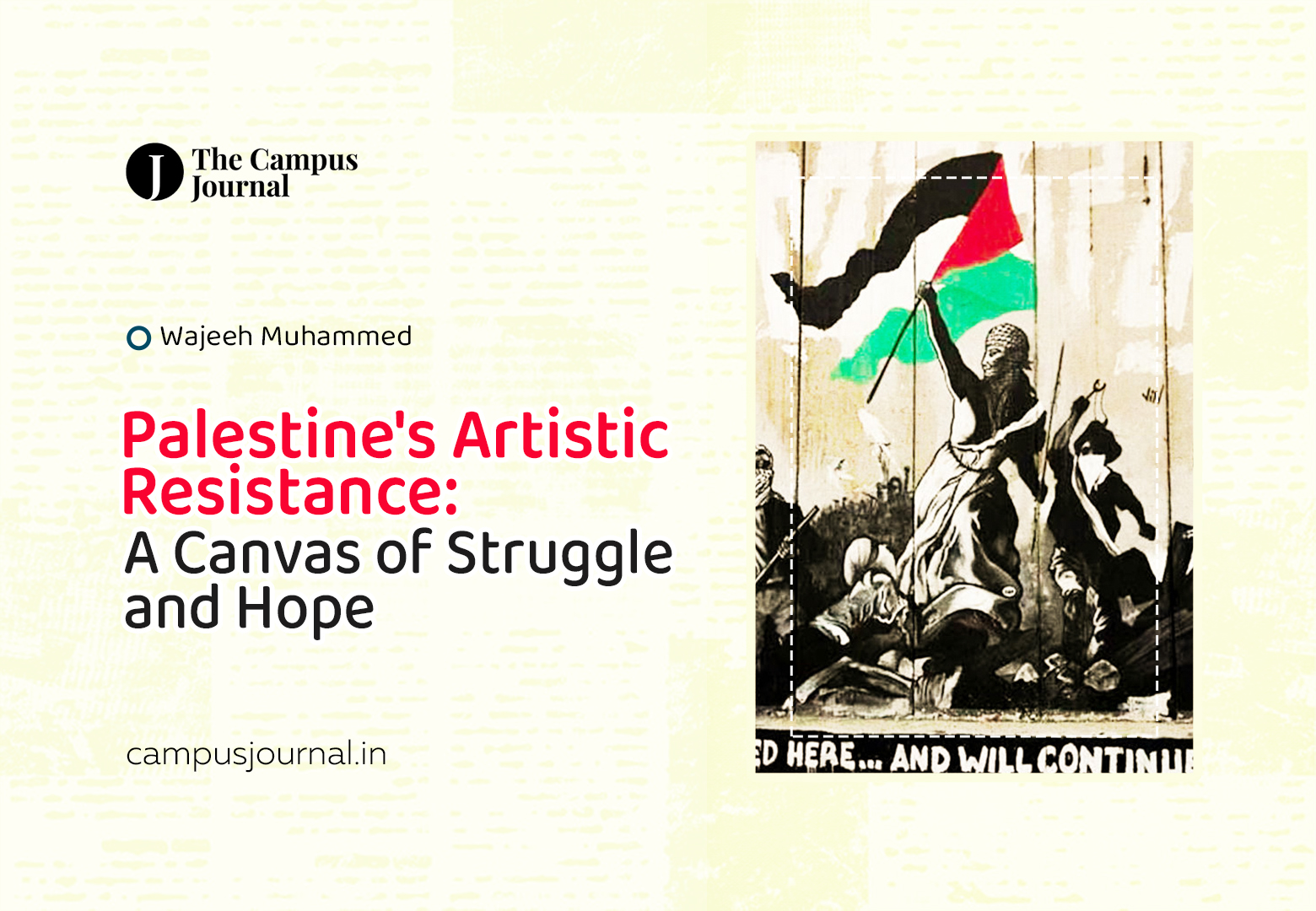
The attempt to use the great potential of the artistic revolution as a form of resistance was made in Palestine even before the Arab Revolution. However, it was merely written down as a small chapter in the Israel-Palestine conflict. Nevertheless, the extent to which Palestinian documentation helped the Arab Revolution learn about Graffiti and Calligraffiti is indescribable.
The Arab Revolution, which demonstrated the importance of streets, raised walls, and surfaces for revolutions, also gifted the world several Muslim artists. The reaction of the young Lebanese artist Yazan Halwani against sectarianism was widely picked up by social media. The streets of Lebanon embraced graffiti art through Yazan Halwani. Manal Al Dowayan, Hossein Amirsadeghi, Amani Hasan, Othman Lazraq, Sascha Crasnow, Nadine Abdel Ghaffar, Ganzeer, and Fatenn Mostafa were also appointed to lead this field in different ways. With Western media picking up numerous reactions such as ‘War of the Walls’ and ‘Graffiti: Street art revolution and the Arab Spring,’ Graffiti and Calligraffiti gradually began to shift beyond the realm of mere appreciation.
The streets of Egypt fully experienced the heat and passion of the artistic revolution. When the squares were occupied by protestors, it was natural for the walls and roads to feel like a canvas to the artists among them. The revolution succeeded in bringing about several popular movements under the names Syrian Graffiti, Beirut Graffiti, Bahrain’s Graffiti, and Tunisian Graffiti. The significance of street art in the Arab Revolution that swept across North Africa and the Arab world lies in the fact that the leaders and followers were able to utilize the possibilities in a distinct and organized manner.

Good write up on Calligraffiti.. thanks.